Weaving Timber and Steel
Workshop By Manjunath BL
Project by Eesha Pethe, Janhavi Naik, Krisha Kothari, Nikhil Ovhal,
Radhika Malekar and Shreya Mittal
In this workshop we were essentially looking at understanding steel as a material. With this we were also thinking of assemblies of different materials, but by the virtue of their material property.
The material property here dictates the form and the geometry of the structure. The form and the geometry were derived from the surroundings and keen observations from everyday life.
The central argument of the exercise was to challenge conventional ways of construction by using thick members and think through fragmenting the elements to make lighter sections. In order to do this, the design process would include a deeper understanding of the material and its several possibilities of joineries. Steel as a material allows it to be intertwined with each other in many ways. This forms a “weave”. The weave is a pattern which can be altered in ways in which it can afford to create dynamic forms with intricate details.
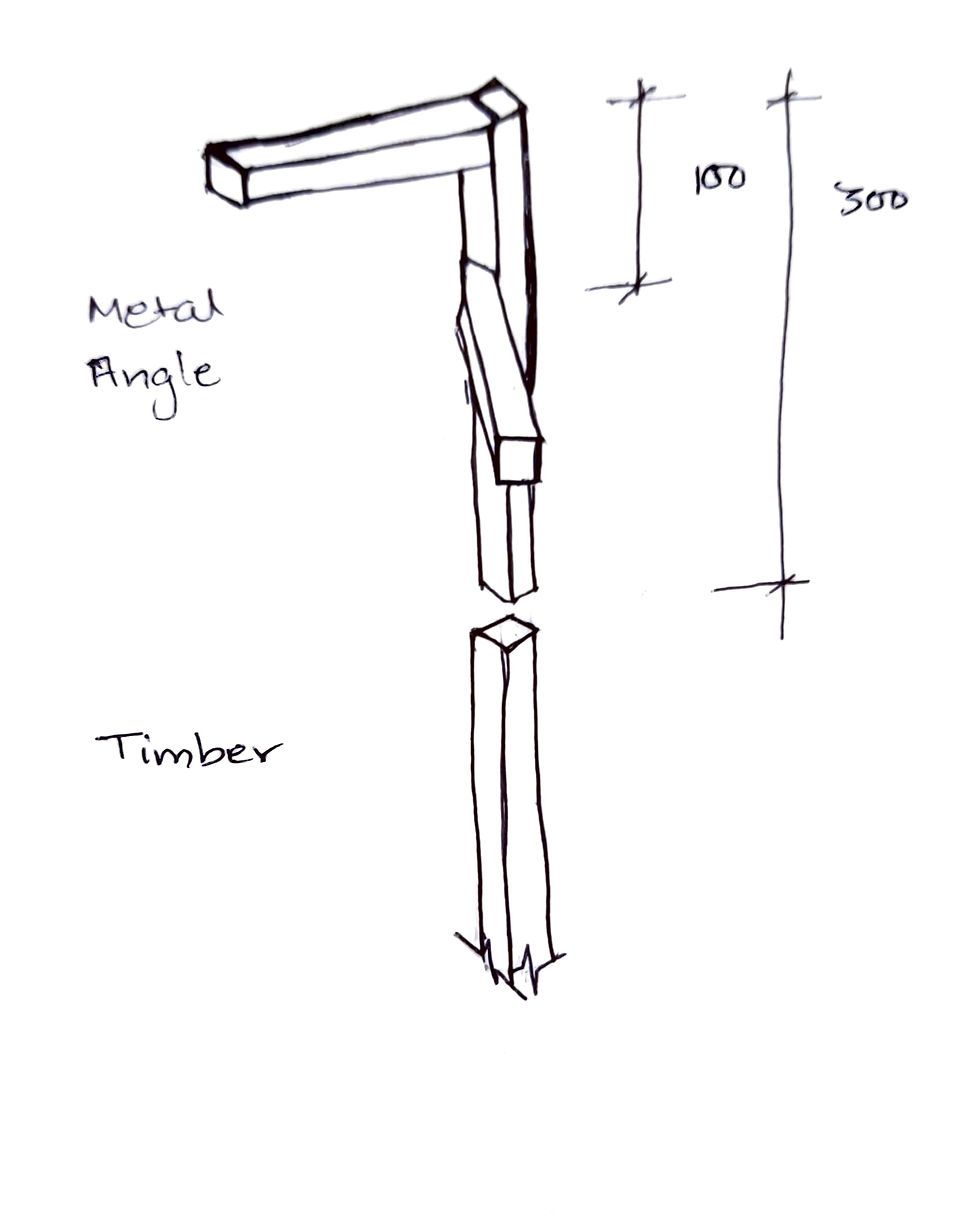
The exercise was about using a timber post of a small cross section of about 40mm and coupling it with steel to create a pavilion. The approach was such that instead of using one single thick member, multiple smaller thin members were used to distribute the load and make a stable structure which also was not too bulky in its appearance.


The initial stages of the design process were inspired by looking at the logic of connector pens. These pens have a logic of connecting parallely and they have the possibility of shifting along the y-axis. In order to stabilize the slender timber members by preventing them from buckling, we introduced a steel element, which here was an angled plate. The design was thus imagined to be a transition space between two exhibition spaces which would be porous enough to allow for free flow of movement but also have a sense of direction while moving through the space.
Iteration 1:




Iteration 2:
in order to make the structure stronger, we changed the column alignment to compliment the overall geometry of the structure. this provided stability in different axes and hence tied the structure better.


